Executive summary
HOW TO READ THE NUMBERS
The method compares texts by how they use the most common words (the, of, unto, that…) — habits authors apply unconsciously — using Burrows' Delta, the standard measure in forensic authorship work. Results are reported as Cohen's κ (kappa): 1.0 means every 2,000-word sample was matched to the right author, 0 means no better than guessing. Each test is run two ways. The naive way lets a sample match any other sample, including its own neighbouring pages — this is effectively how the well-known older studies worked. The strict way (“blocked”) only counts a match if the style carries across separate books — neighbouring pages share topic and vocabulary regardless of who wrote them, so this is the test that isolates authorship.
1 · DOES THE METHOD WORK?
Yes. On six known authors of the same era it identifies the true author of a 2,000-word sample at κ = 0.88 even on the strict test — and it cleanly tells apart two other deliberate King-James imitations. The instrument is sound.
2 · DO THE INTERNAL NARRATORS HAVE DISTINCT “WORDPRINTS”?
Not detectably. The claimed effect reproduces only under the original studies' flawed design, which also certifies fake narrators sliced from one narrator's text (κ 0.61). On the strict test, narrator identification falls to κ 0.21 — versus 0.88 for real authors — and Jacob, Moroni, and every embedded speaker drop to roughly zero.
3 · DOES IT MATCH ANY 19TH-CENTURY CANDIDATE?
No. 83–86% of its samples are farther from every candidate than genuine same-author text ever is. Spalding's style is among the farthest of all candidates; Rigdon's is far too. The forced-choice “winner” is an unrelated Scottish KJV-imitator — the method is matching biblical style, not authorship.
Read both ways, honestly: stylometry offers no support for multiple ancient authors, and it actively disfavors the Spalding–Rigdon theory. But “matches nobody” cannot rule Joseph Smith in or out either — no candidate left a surviving sample of sustained scripture-imitating narrative in his natural voice, and a person's letter-writing style is not their deliberate-imitation style. Neither side should cite stylometry as strong evidence. (A follow-up study addresses this gap by comparing the Book of Mormon against Joseph Smith's other dictated scripture — the Doctrine & Covenants and Book of Moses — where genre is matched. His revelation voice proves to be the nearest real corpus tested, though still distinguishable; see the companion document, Four Computational Studies on the Origin of the Book of Mormon.)
1Why a new study was needed
The “wordprint” studies cited in favor of the Book of Mormon (Larsen, Rencher & Layton 1980; Hilton 1990) compared blocks of the same narrator's contiguous text against each other, so topic and adjacency could masquerade as authorship. The best-known critical study (Jockers, Witten & Criddle 2008) used closed-set classification that must assign every chapter to someone on its list — a list that omitted Joseph Smith — and concluded Spalding and Rigdon. Holmes (1992) found the internal “authors” cluster together; Schaalje et al. (2011) showed open-set methods match most chapters to nobody. Every one of those disputes gets an explicit control below.
2Validation, then the wordprint claim
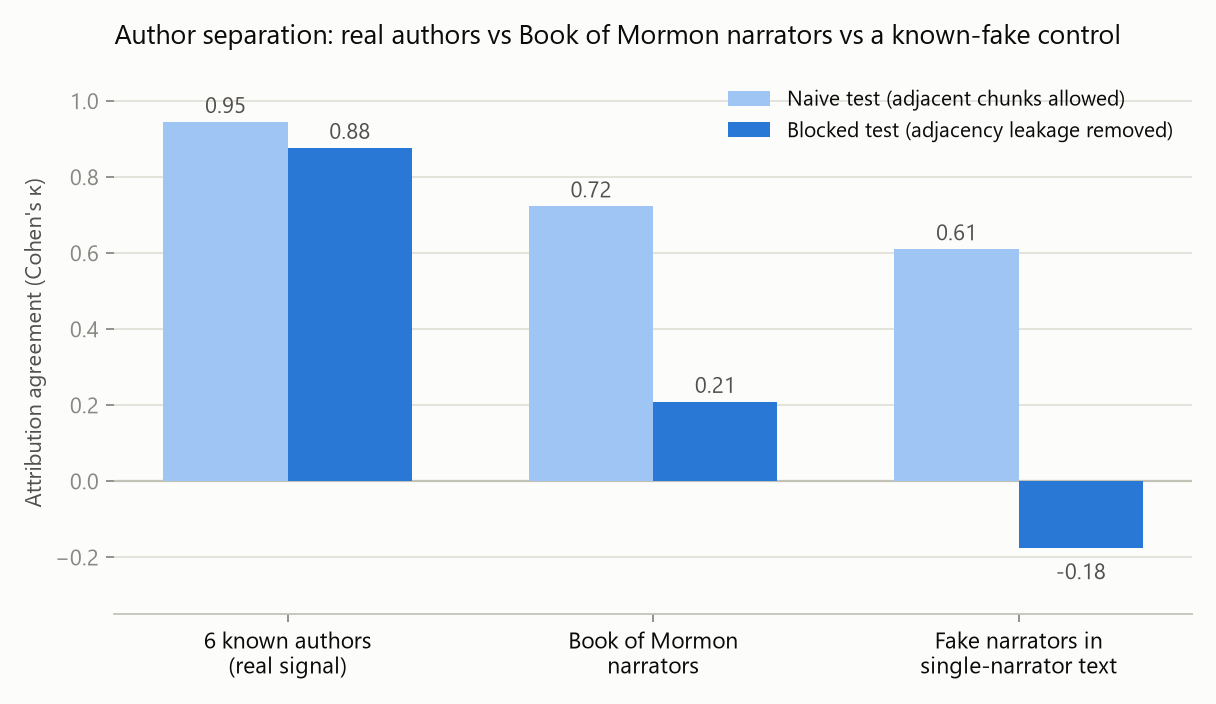
Figure 1 — The headline result. Naive testing (light bars) cannot tell real voices from fake ones: Book of Mormon narrators score 0.72, but arbitrary contiguous slices of a single narrator's text score 0.61. The strict test (dark bars) separates them: real authors keep κ 0.88, Book of Mormon narrators fall to 0.21, fake narrators to chance. The apparent wordprint signal in the older studies comes mostly from comparing neighbouring passages of the same book, which share topic and vocabulary no matter who wrote them.
| TEST (2,000-WORD SAMPLES, 100 MOST-FREQUENT WORDS) | NAIVE Κ | STRICT Κ |
|---|---|---|
| Six known real authors (incl. two KJV imitators) | 0.95 | 0.88 |
| Book of Mormon narrators (Nephi, Jacob, Mormon, Moroni) | 0.72 | 0.21 |
| Fake narrators sliced from Mormon's own text (null) | 0.61 | −0.18 |
On the strict test, how often each narrator's samples are correctly identified: Mormon 76% (he wrote most of the book, which inflates his score), Nephi 37%, Jacob 0%, Moroni 0% — and in the speaker-level test replicating the 1980 study's design, Benjamin, Abinadi, Alma, Amulek, and Samuel all score 0%. The weak signal that remains (κ ≈ 0.2, mostly Nephi-vs-Mormon) is as consistent with a difference of subject matter between the two halves of the book, or drift over a year of dictation, as with different authors.
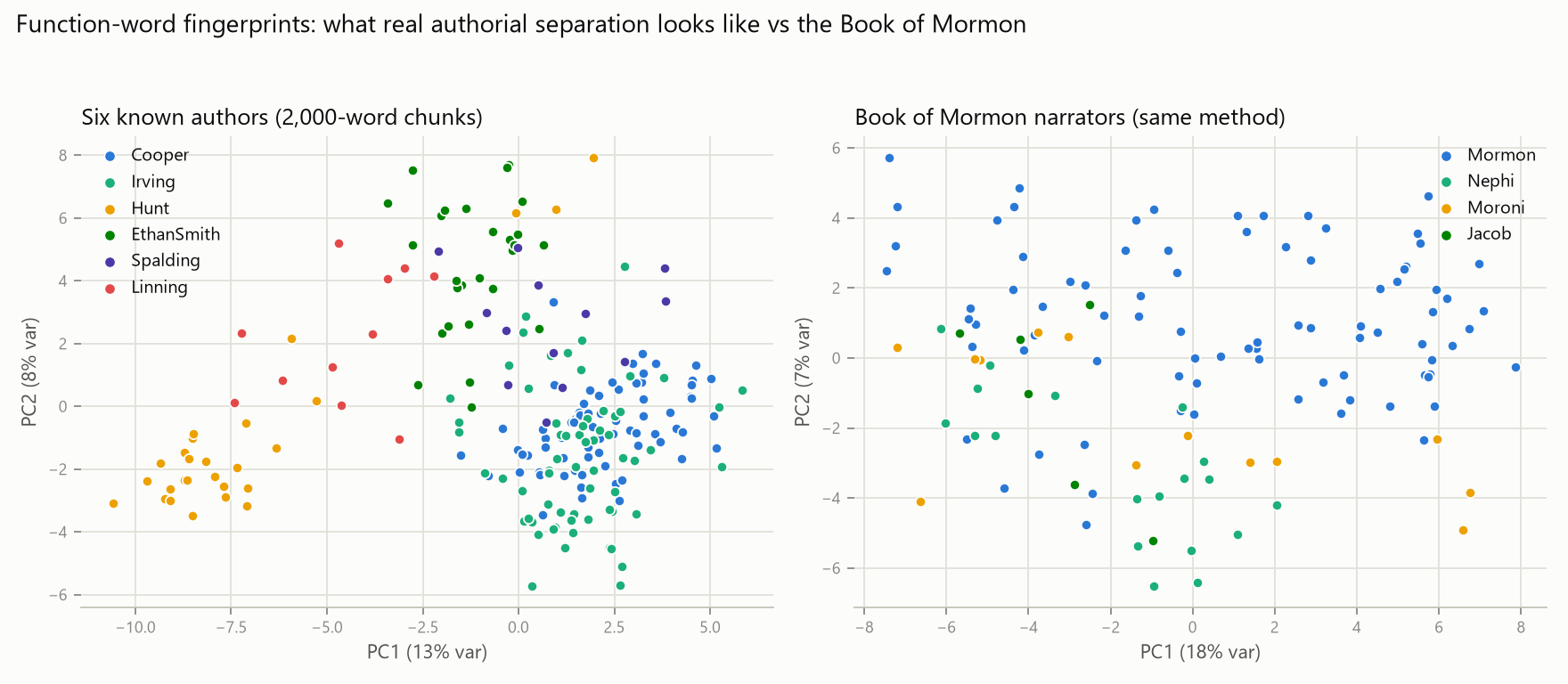
Figure 2 — What separation looks like. A two-dimensional map of the style measurements (the analysis itself uses a hundred; this is the best flat view). Left: known authors form real clusters — even Hunt and Linning, both writing King-James imitation. Right: the Book of Mormon's narrators under the identical method — largely one intermixed cloud.
3The 19th-century candidates
Ten candidates were tested: Joseph Smith (only documents in his own handwriting or dictated by him, from the Joseph Smith Papers verbatim transcripts), Sidney Rigdon (74,000 words of signed prose), Oliver Cowdery, Solomon Spalding (the actual surviving “Manuscript Found”), Parley Pratt, W. W. Phelps, David Whitmer, Ethan Smith (View of the Hebrews), Gilbert Hunt (The Late War), and Michael Linning (First Book of Napoleon, 1809 — a King-James-imitating text by a Scottish lawyer with no connection to Mormonism, included as a control for the biblical style itself). Alongside them, as reference points: two unrelated authors of the era (Washington Irving, James Fenimore Cooper) and the King James Bible itself.
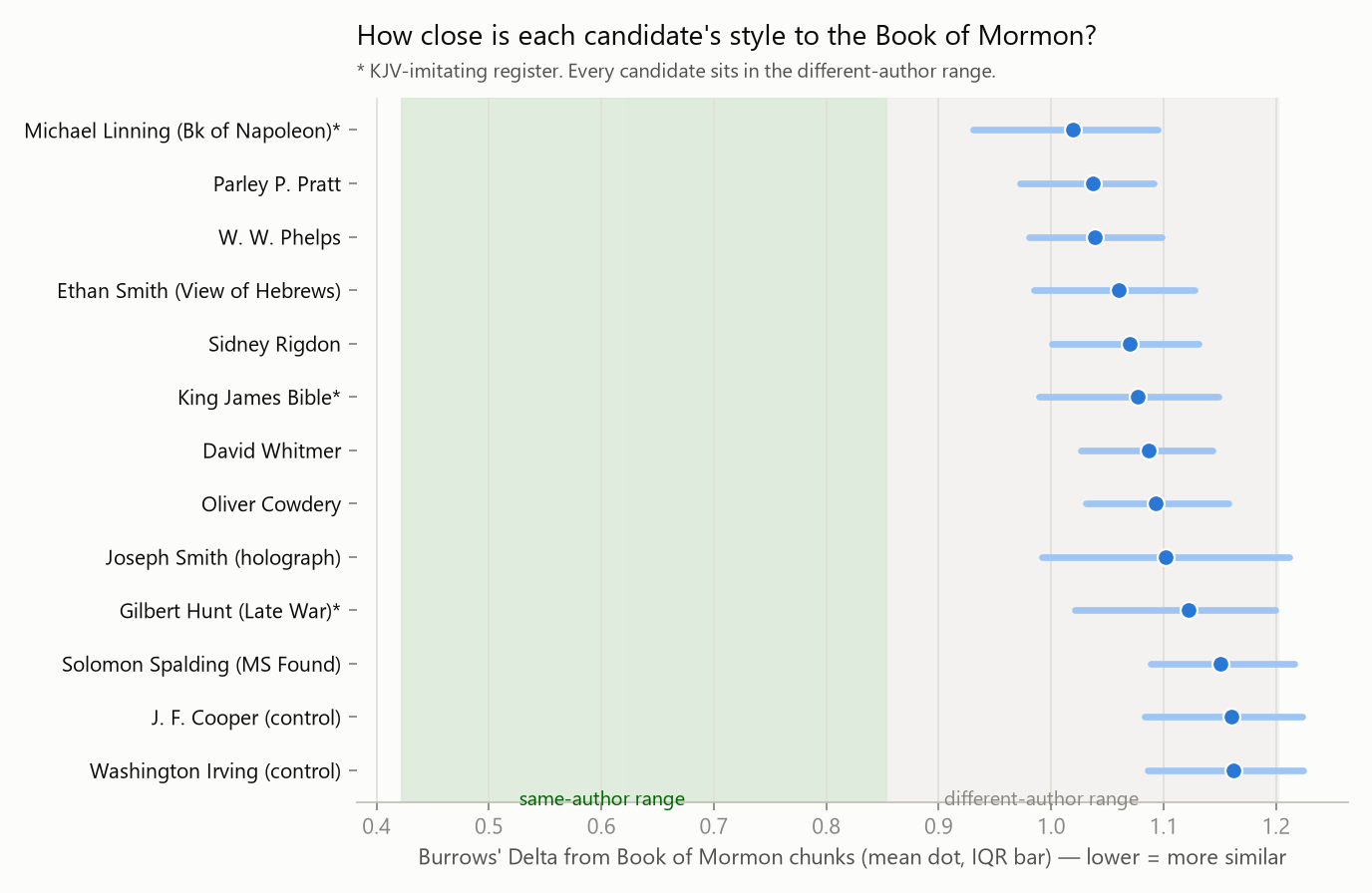
Figure 3 — Nobody is close. Every candidate's distance from the Book of Mormon sits in the range where known different authors fall (grey), far outside the range known same-author text occupies (green). The nearest “candidate” is the style control — and Spalding is farther from the Book of Mormon than almost anyone tested, with Rigdon in the bottom half. The result holds when archaic marker words (unto, yea, behold…) are removed from the measurements.
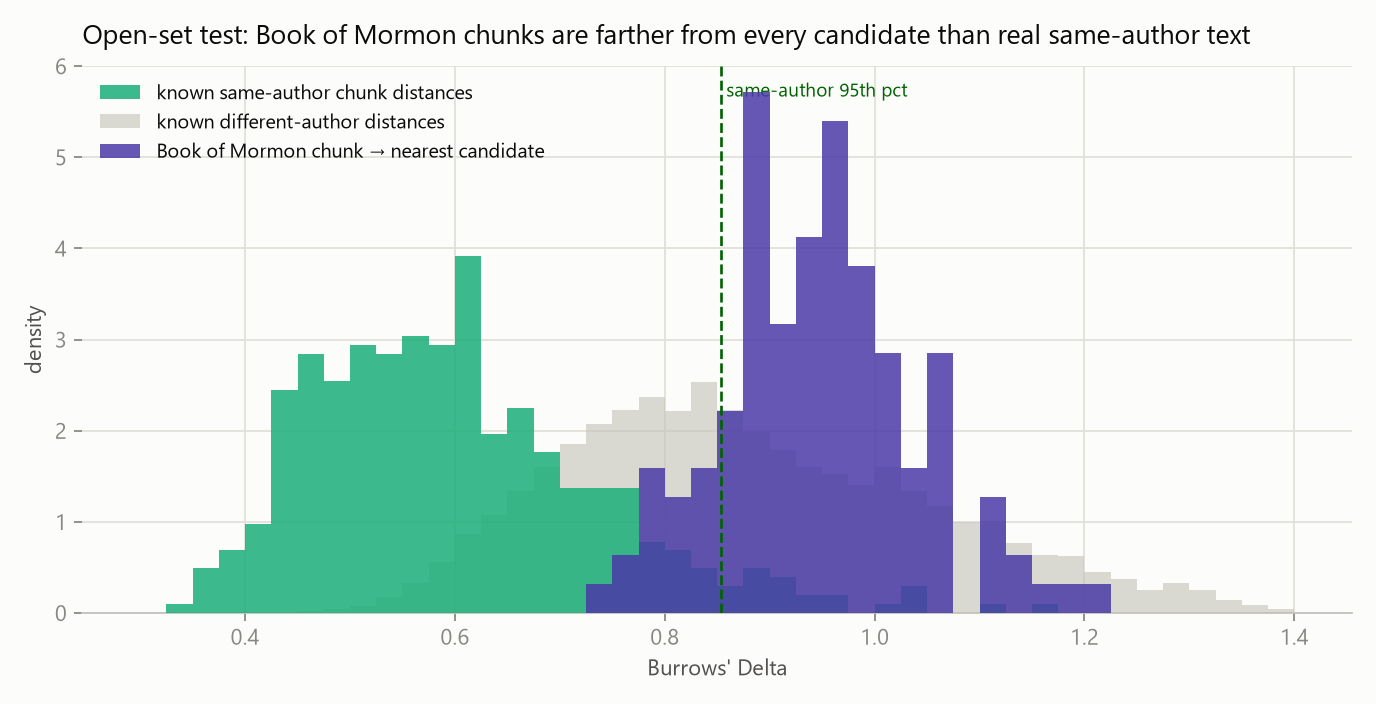
Figure 4 — The open-set test. Green: how far samples of known authors sit from their own author's profile. Violet: each Book of Mormon sample's distance to whichever candidate it is nearest. 83–86% of samples lie farther from every candidate than genuine same-author text almost ever strays — the honest answer is “matches nobody on the list,” not a name.
WHY THE 2008 SPALDING–RIGDON RESULT HAPPENED
The 2008 study used a forced-choice method: every chapter must be assigned to someone on the candidate list, however poor the fit. To show what that does, we deleted a known author (Cooper) from the candidate list and re-attributed his samples: 62 of 74 were confidently — and wrongly — assigned to Washington Irving. Forced to choose for the Book of Mormon, the votes scatter, and the “winner” is Linning (36 of 123) — the unconnected Scottish style control — with Spalding receiving zero. A method that crowns an unrelated Scottish lawyer is measuring biblical style, not authorship.
What the Book of Mormon's style actually is: dramatically over-used came (from “it came to pass”), should, that, they, unto, people, now, many, them, land; under-used articles and prepositions (a, an, in, on, at, from, with). One sustained, formula-driven imitation of King James narrative, consistent across all its narrators and unlike any candidate's natural prose — including, for what little his 20,000-word surviving corpus can show, Joseph Smith's own letters.
4Limitations — read before quoting
The style-of-writing confound cuts both ways. None of the candidates left a sustained scripture-imitating narrative in his natural voice; a person's letter-writing style is not their deliberate-imitation style. “Matches nobody” therefore does not prove that no 19th-century person wrote it. (The follow-up study against Joseph Smith's other dictated scripture addresses this directly — see the companion document.)
Joseph Smith's reliable corpus is small (~20,000 words — only documents in his own hand or dictated by him) and in a different genre (letters, not narrative). His distance should not be over-read in either direction.
Transmission noise: the texts passed through scribes, typesetters, and (for four candidate corpora) modern text-scanning errors; the Pratt text follows an 1881 edition, and Whitmer wrote in 1887. The common-word measurements are robust to most of this, but it is not zero.
Narrator assignments are made chapter by chapter, which is approximate (chapters mix narration and quoted speech); both the narrator-level and speaker-level schemes were tested and agree.
The weak leftover narrator signal (κ ≈ 0.2) is real but cannot be assigned a cause — author, subject matter, genre, and drift over the months of dictation are tangled together inside a single text.
5Bottom line
The stylometric argument for the Book of Mormon (distinct wordprints) fails its own controls: the design that produces it also finds “distinct authors” inside text known to have one narrator. The best-known stylometric argument against it (the Spalding–Rigdon attribution) also fails: by direct distance measurement its two proposed authors are among the worst matches available, and the forced-choice method that produced it misattributes 84% of a known author's text when the true author is missing from its list. What remains, stated plainly: the Book of Mormon is stylometrically one sustained pseudo-biblical idiom that cannot be pinned on any tested author — a result that supports neither the ancient-authors claim nor a specific modern-author claim, and leaves the book's origin to be argued on other evidence.
6Data and methods (summary)
| CORPUS | WORDS | SOURCE / NOTES |
|---|---|---|
| Book of Mormon | 252,099 | scriptures-json (current LDS ed.); 14,839 words of KJV block quotation excluded |
| Joseph Smith | 19,800 | Joseph Smith Papers verbatim transcripts; 15 documents in his own hand + 2 dictated |
| Sidney Rigdon | 74,300 | 26 signed documents; joint-authored, disputed, and Lectures on Faith excluded |
| Oliver Cowdery | 44,300 | 19 signed documents; 1839 “Defence” excluded as probable forgery |
| Solomon Spalding | 28,300 | The surviving Oberlin manuscript (1885 printing, OCR) |
| Parley P. Pratt | 35,300 | A Voice of Warning (1837; 1881 ed. text); quotes stripped |
| W. W. Phelps | 62,800 | 14 Evening and the Morning Star issues (1832–33); quotes/reprints stripped |
| David Whitmer | 31,300 | Address to All Believers (1887; late date noted) |
| Ethan Smith | 56,600 | View of the Hebrews (1823) |
| Gilbert Hunt | 57,400 | The Late War (1816), deliberate KJV style |
| Michael Linning | 22,800 | First Book of Napoleon (1809), biblical-style control |
| Irving / Cooper / KJV | 128k / 148k / 120k | Unrelated-author controls and biblical reference |
Methods in brief: relative frequencies of the 100 most frequent words (50, 100, and 200 all tested), standardized per Burrows; Delta distance; leave-one-out nearest-neighbour attribution with the strict same-book blocking described above; Cohen's κ; author-profile attribution with the forced-choice (“lesion”) demonstrations; open-set thresholds calibrated on known same-author text; and sensitivity runs with archaic/biblical marker words removed (no conclusion changed). Complete methods, formulas, sensitivity grids, a permutation significance test, per-document source records for every corpus, and all numeric outputs are in the companion technical manuscript; every figure and number in this summary regenerates from the analysis scripts.
COMPANION DOCUMENTS
Four Computational Studies on the Origin of the Book of Mormon — four follow-up studies in reader-friendly form (the Late War phrase claim under a proper control; the King James italics, counted in full; New Testament phrasing in pre-Christian text; and the Book of Mormon beside Joseph Smith's other dictated scripture). Stylometric Analysis of the Book of Mormon — Full Manuscript — the complete technical write-up of this study, with methods, formulas, full result grids, limitations, and appendices.
7Prior literature
Larsen, Rencher & Layton, “Who Wrote the Book of Mormon? An Analysis of Wordprints,” BYU Studies 20 (1980).
Hilton, “On Verifying Wordprint Studies,” BYU Studies 30 (1990).
Holmes, “A Stylometric Analysis of Mormon Scripture and Related Texts,” Journal of the Royal Statistical Society A 155 (1992).
Jockers, Witten & Criddle, “Reassessing Authorship of the Book of Mormon Using Delta and Nearest Shrunken Centroid Classification,” Literary & Linguistic Computing 23 (2008).
Schaalje, Fields, Roper & Snow, “Extended Nearest Shrunken Centroid Classification: A New Method for Open-Set Authorship Attribution of Texts of Varying Sizes,” Literary & Linguistic Computing 26 (2011).