July 2026 · All corpora, code, per-document provenance manifests, and numeric outputs accompany this manuscript (directory stylometry/)
Abstract
Two contradictory stylometric literatures surround the Book of Mormon (1830): “wordprint” studies reporting that its internal narrators exhibit mutually distinct, non-19th-century styles (Larsen et al., 1980; Hilton, 1990), and a closed-set classification study attributing most of its chapters to Sidney Rigdon and Solomon Spalding (Jockers et al., 2008). We re-examine both claims with a single validated pipeline: relative frequencies of the 100 most frequent words, Burrows' Delta, and leave-one-out attribution, applied to 252,099 words of Book of Mormon text (with King James block quotations removed), ten 19th-century candidate authors (~433,000 curated words), and calibration controls. The pipeline separates six known contemporaneous authors at κ = 0.88 under adjacency blocking, including two deliberate King-James imitations. Applied to the Book of Mormon narrators, apparent discrimination is high under the naive designs of the wordprint literature (κ = 0.72) but collapses under blocking (κ = 0.21); a null control — pseudo-narrators cut from a single narrator's text — scores κ = 0.61 naive, confirming that naive designs manufacture author signal from topical adjacency. A section-level permutation test finds the residual narrator signal weak though nominally significant (blocked accuracy 0.55 vs. null mean 0.27; p = .035). In open-set attribution, 83–86% of Book of Mormon chunks lie farther from every candidate than the 95th percentile of genuine same-author distances; Spalding and Rigdon rank among the most distant candidates, and forced closed-set attribution selects a register-matched control author with no historical connection to the text. A lesion experiment shows the closed-set design misattributes 84% of a known author's chunks when the true author is withheld. We conclude that function-word stylometry supports neither the multiple-ancient-authors claim nor any specific modern-candidate attribution, and we document the genre confounds that bound what stylometry can decide here.
1Introduction
The Book of Mormon presents an unusual authorship problem. The text presents itself as the work of multiple ancient authors (principally the narrators Nephi, Jacob, Mormon, and Moroni) translated by one man, Joseph Smith, in 1829; skeptical accounts attribute it to Smith himself or to contemporaries, most prominently Solomon Spalding and Sidney Rigdon. Both sides have claimed stylometric support, and both bodies of work have drawn serious methodological criticism.
1.1 Prior work
Larsen, Rencher and Layton (1980) computed function-word rates over blocks assigned to the text's internal speakers and reported, via MANOVA and classification, that the “wordprints” of internal authors differ from one another and from 19th-century candidates. Hilton (1990) reported similar conclusions with different statistics. Both studies share a structural weakness: blocks of the same speaker's contiguous text appear on both sides of every comparison, so any position- or topic-linked variation (narrative vs. sermon, war chapters vs. doctrinal chapters) counts as authorial signal. Neither study included a null control on text of known single authorship.
Holmes (1992), by contrast, found that samples from the Book of Mormon's internal authors cluster together rather than separately against related corpora. Jockers, Witten and Criddle (2008) applied Delta and nearest shrunken centroid (NSC) classification with a closed candidate set — excluding Joseph Smith on the ground that no uncontested holograph corpus existed — and attributed most chapters to Rigdon or Spalding. Schaalje, Fields, Roper and Snow (2011) extended NSC to open-set attribution and showed that under an open-set model most Book of Mormon chapters match none of Jockers' candidates. Each side of the apologetic divide thus possesses one favourable study and one unfavourable; none of the four combines a validated pipeline, adjacency controls, a single-author null, and open-set calibration in one design. That combination is this study's contribution.
1.2 Research questions
RQ1. Can the chosen method discriminate known authors of the relevant period, genre range, and register at the available sample sizes? (If not, nothing further is interpretable.)
RQ2. Do the Book of Mormon's internal narrators and embedded speakers exhibit statistically separable styles once adjacency and topic leakage are controlled?
RQ3. Does the Book of Mormon's style match any tested 19th-century candidate under open-set assumptions, and how do closed-set designs mislead here?
2Materials
2.1 Book of Mormon text and segmentation
We use the current LDS edition in structured JSON form (bcbooks/scriptures-json; 239 chapters, 6,604 verses). Wording differences from the 1830 first edition are almost entirely grammatical regularizations; their effect on high-frequency word rates is small but noted as a limitation (§6). Chapters consisting predominantly of King James Bible block quotation were excluded in full, since their style is that of the KJV translators rather than of whoever produced the Book of Mormon: 24 chapters, 14,839 words (Appendix A lists them). Two further chapters flagged as dense Isaiah paraphrase (2 Nephi 26–27) were retained but marked. The retained text comprises 252,099 words in 215 chapters.
Narrator labels were assigned at chapter level (Appendix A gives the full mapping): Nephi (39,874 words), Jacob (13,376, including his long sermon quoted in 2 Nephi 6–10), Mormon (169,564), Moroni (26,000), and “minor” (Enos/Jarom/Omni, 3,285 — excluded from classification as too small). A secondary speaker-level scheme additionally isolates the five largest embedded orations, approximating the design of the wordprint studies: Benjamin (Mosiah 2–5; 5,564 words), Abinadi (Mosiah 12–17 less 14; 4,619), Alma (Alma 5, 7, 36–42; 11,978), Amulek (Alma 34; 1,574), Samuel (Helaman 13–15; 3,917). Chapter-level assignment is approximate (chapters mix narration and speech); both schemes were analysed.
2.2 Candidate corpora
Ten candidates were assembled under written inclusion rules: only text attributable to the candidate as author (signed, or editorially attributable with confidence recorded); quoted scripture and quoted third-party material stripped; known forgeries and disputed-authorship works excluded; per-document provenance, source URL, scribal status, and confidence recorded in machine-readable manifests accompanying the corpus. Table 1 summarizes.
Table 1. Candidate and control corpora. Words are post-cleaning token counts as analysed.
| Author | Words | Docs | Composition and notable exclusions |
|---|---|---|---|
| Joseph Smith | 19,825 | 17 | JSP verbatim transcripts; 15 holograph + 2 dictated (Liberty Jail epistles); excludes all scribe-composed histories, D&C revelations, King Follett (reconstructed) |
| Sidney Rigdon | 74,300 | 26 | 1840 Appeal (embedded affidavits removed), 1838 oration (pamphlet text), 16 signed 1834–38 newspaper pieces, 1844 Pittsburgh items; excludes Lectures on Faith (disputed), joint-signed and unsigned items |
| Oliver Cowdery | 44,332 | 19 | Eight 1834–35 historical letters, signed M&A and Evening & Morning Star pieces; excludes the 1839 “Defence” (probable forgery) and brother Warren Cowdery's editorials |
| Solomon Spalding | 28,254 | 1 | The surviving Oberlin “Manuscript Story” (1885 verbatim printing, OCR); 1885 correspondence removed |
| Parley P. Pratt | 35,259 | 1 | A Voice of Warning (1837; text follows 1881 ed.); Chapter VII (KJV contrast table) and all quoted spans removed |
| W. W. Phelps | 62,825 | 14 | Editorial matter of the 14 Evening and the Morning Star issues he edited (1832–33); revelations, reprints, letters by others, verse, and unmarked scripture removed by filter + manual adjudication |
| David Whitmer | 31,302 | 1 | An Address to All Believers in Christ (1887); quoted scripture stripped; late date noted |
| Ethan Smith | 56,555 | 1 | View of the Hebrews (1823 1st ed., OCR) |
| Gilbert Hunt | 57,414 | 1 | The Late War (1816) — deliberate KJV-style history; register-matched candidate |
| Michael Linning | 22,833 | 1 | The First Book of Napoleon (1809) — deliberate KJV-style; register control with no historical connection to the Book of Mormon |
| Irving (control) | 128,470 | 1 | The Sketch-Book (1819–20); distractor |
| Cooper (control) | 148,434 | 1 | The Last of the Mohicans (1826); distractor |
| KJV (reference) | 120,000 | — | Narrative/prophetic book sample; register reference |
2.3 Preprocessing
All texts: header/manifest lines and bracketed editorial insertions removed; hyphen-linebreak splits joined; running heads and page numbers removed; whitespace collapsed. Tokenization lowercases and extracts maximal [a-z'] strings; original 19th-century spelling is retained (function words are spelled conventionally in all corpora). Four corpora (Spalding, Hunt, Linning, E. Smith) derive from OCR; the remainder are human transcriptions. OCR effects are assessed in §6.
3Methods
3.1 Features and distance
Documents are divided into contiguous, non-overlapping chunks of w tokens (w ∈ {1000, 2000}; trailing remainders dropped). The feature vocabulary is the m most frequent word types in the analysis corpus (m ∈ {50, 100, 200}); such lists are dominated by function words, the standard authorship signal since Mosteller and Wallace (1964). Each chunk is represented by relative frequencies fi, standardized per corpus: zi(x) = (fi(x) − μi)/σi. Distance is Burrows' (2002) Delta, Δ(x, y) = (1/m) Σ |zi(x) − zi(y)|. Robustness to the metric is checked with cosine Delta (Evert et al., 2017), d(x, y) = 1 − cos(z(x), z(y)) (§4.5).
3.2 Attribution tests and adjacency blocking
Chunk-level attribution uses leave-one-out nearest-neighbour (LOO-NN): each chunk is assigned the label of its nearest other chunk. We report two variants. Naive: any other chunk may be the neighbour — this reproduces the effective design of the wordprint literature, in which contiguous same-speaker blocks are compared. Blocked: chunks originating in the same source document (for the Book of Mormon, the same book; for validation works, the same quarter of the work) are excluded as neighbours, so a label is recovered only if its style persists across separate texts. Blocking removes the leakage by which two adjacent chunks — sharing topic, scene, and vocabulary — match regardless of authorship. Candidate attribution (§4.3) uses distance to author centroids, with leave-one-out centroids for same-author calibration.
3.3 Agreement statistic
Because class balance differs across tasks (the narrator task is 69% Mormon), raw accuracy is not comparable; we report Cohen's κ = (po − pe)/(1 − pe), the chance-corrected agreement between predicted and true labels (κ = 1 perfect, κ = 0 chance-level, κ < 0 worse than chance).
3.4 Controls
Positive control (RQ1). The full pipeline applied to six known single-author works of 1809–1826 spanning the register range of interest, including two deliberate KJV imitations (Hunt, Linning) and one OCR text (Spalding), at every combination of w and m, with and without capping each author at 12 chunks to test small-sample behaviour.
Negative control (RQ2). The narrator with the largest corpus (Mormon, 169,564 words spanning seven books) was cut into four contiguous pseudo-narrators with the same relative sizes as Nephi/Jacob/Mormon-remainder/Moroni, and the identical pipeline applied. Any “discrimination” of these pseudo-narrators is by construction non-authorial.
Permutation test (RQ2). Fifteen maximal contiguous same-narrator chapter runs (“sections”) form the exchangeable units (Mormon 7, Nephi 3, Moroni 3, Jacob 2). Chunks are built within sections; the statistic is section-blocked LOO-NN accuracy; the null distribution is obtained by permuting section labels (1,000 permutations, seed 42).
Lesion test (RQ3). A known author (Cooper; also Spalding) is deleted from the candidate list and his chunks re-attributed, measuring the closed-set false-attribution rate that any forced-choice design incurs when the true author is absent.
Open-set calibration (RQ3). The distribution of genuine same-author distances (each candidate chunk to its own author's leave-one-out centroid) defines an empirical same-author range; a Book of Mormon chunk whose distance to its nearest candidate exceeds the 95th percentile of that distribution is unlike every candidate's own within-author variation.
Register sensitivity. All attribution analyses were repeated with 27 archaic/biblical marker words (unto, yea, behold, thou, thee, ye, hath, wherefore, verily, saith, etc.) removed from the feature list before selecting the top 100, testing whether results are driven by KJV register rather than authorial habit.
3.5 Software and reproducibility
Python 3.13.7 with numpy (BLAS double precision) and matplotlib; all analysis code (9 scripts, ~1,100 lines), corpora, per-document manifests, and numeric outputs accompany this manuscript. Analysis decisions (chunk sizes, feature counts, exclusion lists, blocking rules) were fixed by design before candidate results were seen; the full sensitivity grid is reported rather than a selected cell.
4Results
4.1 RQ1: the method discriminates known authors
Table 2. Validation on six known authors. LOO-NN accuracy (κ). Cap-12 rows: each author limited to 12 chunks spread evenly through the work.
| w | m | Sample | Chunks | Naive acc (κ) | Blocked acc (κ) |
|---|---|---|---|---|---|
| 1000 | 100 | all | 436 | .91 (.88) | .83 (.77) |
| 1000 | 100 | cap 12 | 72 | .74 (.68) | .69 (.63) |
| 1000 | 200 | all | 436 | .96 (.95) | .89 (.85) |
| 1000 | 200 | cap 12 | 72 | .85 (.82) | .75 (.70) |
| 2000 | 100 | all | 217 | .96 (.95) | .91 (.88) |
| 2000 | 100 | cap 12 | 71 | .87 (.85) | .86 (.83) |
| 2000 | 200 | all | 217 | .98 (.97) | .93 (.91) |
| 2000 | 200 | cap 12 | 71 | .92 (.90) | .86 (.83) |
At the primary setting (w = 2000, m = 100; bold row) blocked accuracy is 0.91 (κ = 0.88) against a 6-class majority baseline of 0.34. Per-author blocked accuracy: Cooper 0.97, Irving 0.91, Hunt 0.85, E. Smith 0.85, Linning 1.00, Spalding 0.69 (the one OCR-noisiest and shortest corpus). Hunt and Linning — two independent KJV imitations — are confused in only 1 of 38 blocked decisions: shared biblical register does not defeat the method when authors genuinely differ. Small-corpus behaviour (cap-12: κ = 0.83) bounds the attenuation expected for candidates with few chunks.
4.2 RQ2: internal narrator discrimination fails its controls
Table 3. Narrator discrimination vs. the pseudo-narrator null across the sensitivity grid. Values are LOO-NN accuracy (κ).
| w | m | BoM narrators naive | BoM narrators blocked | Null naive | Null blocked |
|---|---|---|---|---|---|
| 1000 | 50 | .75 (.50) | .52 (.06) | .70 (.47) | .33 (−.11) |
| 1000 | 100 | .81 (.63) | .53 (.12) | .75 (.59) | .22 (−.19) |
| 1000 | 200 | .87 (.73) | .64 (.27) | .79 (.65) | .28 (−.10) |
| 2000 | 50 | .82 (.64) | .54 (.12) | .70 (.49) | .27 (−.19) |
| 2000 | 100 | .86 (.72) | .58 (.21) | .76 (.61) | .25 (−.18) |
| 2000 | 200 | .88 (.75) | .60 (.25) | .81 (.68) | .26 (−.17) |
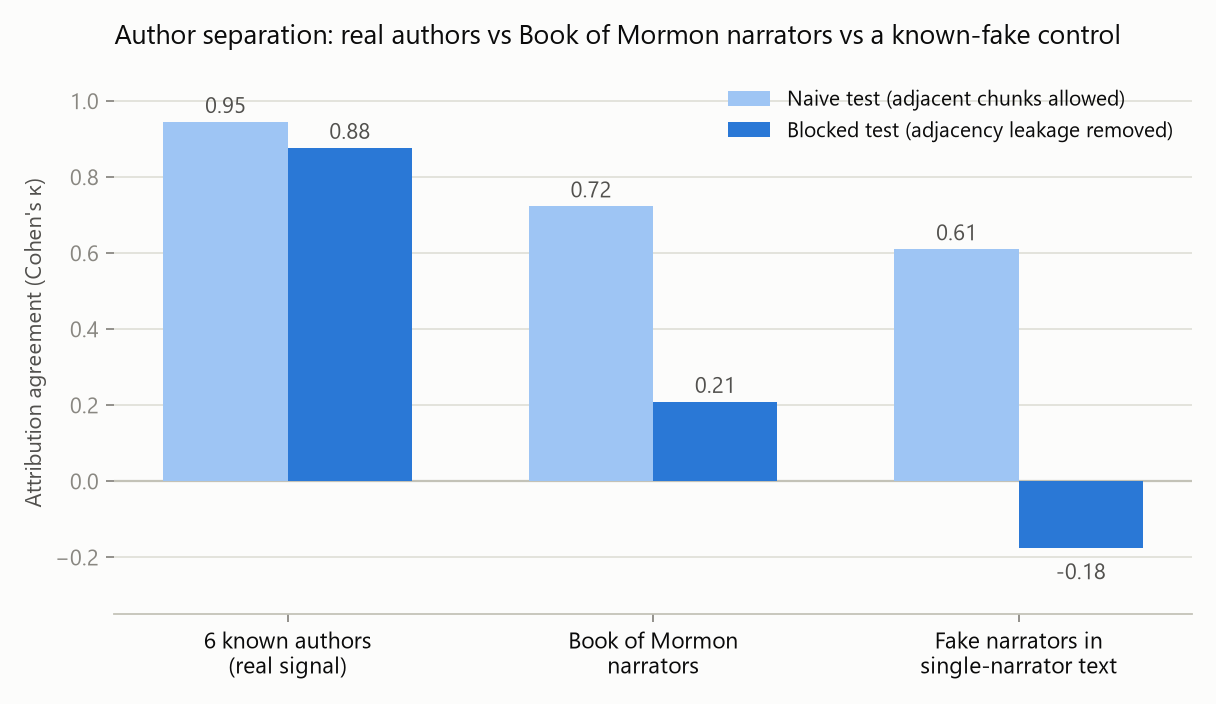
Figure 1. Naive vs. blocked attribution (κ) for real authors, Book of Mormon narrators, and the pseudo-narrator null (w = 2000, m = 100). Naive testing assigns high scores to fake narrators (0.61); blocking separates real signal (0.88) from the Book of Mormon narrators (0.21) and the null (−0.18).
Three observations. (i) Under the naive design the null scores κ = 0.47–0.68 — arbitrary contiguous slices of one narrator's text are “discriminated” nearly as well as the true narrators (0.50–0.75), demonstrating that the design of the wordprint studies manufactures authorship signal from adjacency. (ii) Blocking collapses narrator κ to 0.06–0.27 while real authors retain 0.77–0.91. (iii) Blocked per-narrator recall at the primary setting: Mormon 0.76, Nephi 0.37, Jacob 0.00, Moroni 0.00. In the speaker-level analysis (w = 1000, m = 100, 8 classes), every embedded orator scores 0.00 blocked recall (Benjamin n = 5, Abinadi n = 4, Alma n = 12, Samuel n = 3 chunks); for comparison, Linning is recovered at 1.00 from n = 11 chunks in validation.
The permutation test bounds the residual signal: observed section-blocked accuracy 0.551 (κ = 0.133) against a permuted-label null of mean 0.269 (SD 0.130), p = .035 (1,000 permutations). The narrator effect is thus nominally significant but an order of magnitude weaker than real authorial separation, and its source cannot be isolated: narrator identity is confounded with genre (small plates first-person memoir vs. abridged war/political narrative) and with dictation order. What the data exclude is the strong claim of the wordprint literature — clearly distinct, reliably recoverable authorial voices.
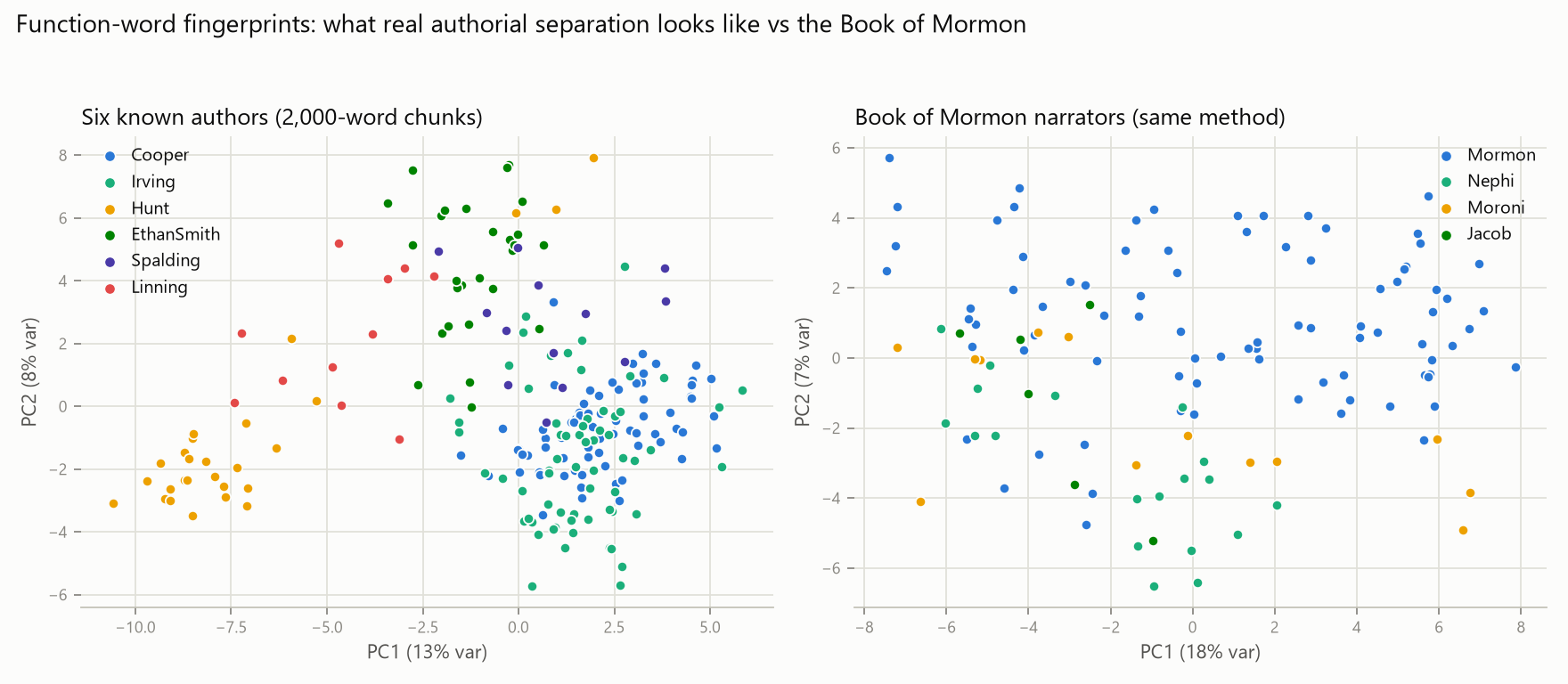
Figure 2. First two principal components of the z-scored feature space (~20% of variance). Left: six known authors form separated clusters (the full 100-dimensional space separates them further). Right: Book of Mormon narrators under the identical method form one intermixed cloud.
4.3 RQ3: open-set attribution matches no candidate; closed-set designs mislead
Feature space and standardization were fit on candidate/control chunks only (excluding the Book of Mormon and KJV), so the largest corpus cannot dominate scaling. Same-author calibration: mean Δ = 0.600, 95th percentile 0.854; different-author: mean 0.881.
Table 4. Mean Delta from the 123 Book of Mormon chunks to each candidate centroid, with closed-set vote counts (nearest centroid per chunk). Full feature set; the no-archaic variant changes no ordering materially.
| Candidate | Mean Δ | Closed-set votes | Candidate | Mean Δ | Closed-set votes |
|---|---|---|---|---|---|
| Linning (register ctrl) | 1.02 | 36 | Whitmer | 1.09 | 2 |
| Pratt | 1.04 | 8 | Cowdery | 1.10 | 2 |
| Phelps | 1.04 | 11 | J. Smith | 1.10 | 22 |
| E. Smith | 1.06 | 3 | Hunt | 1.12 | 10 |
| Rigdon | 1.07 | 6 | Spalding | 1.15 | 0 |
| KJV (reference) | 1.08 | 23 | Cooper / Irving | 1.16 | 0 / 0 |
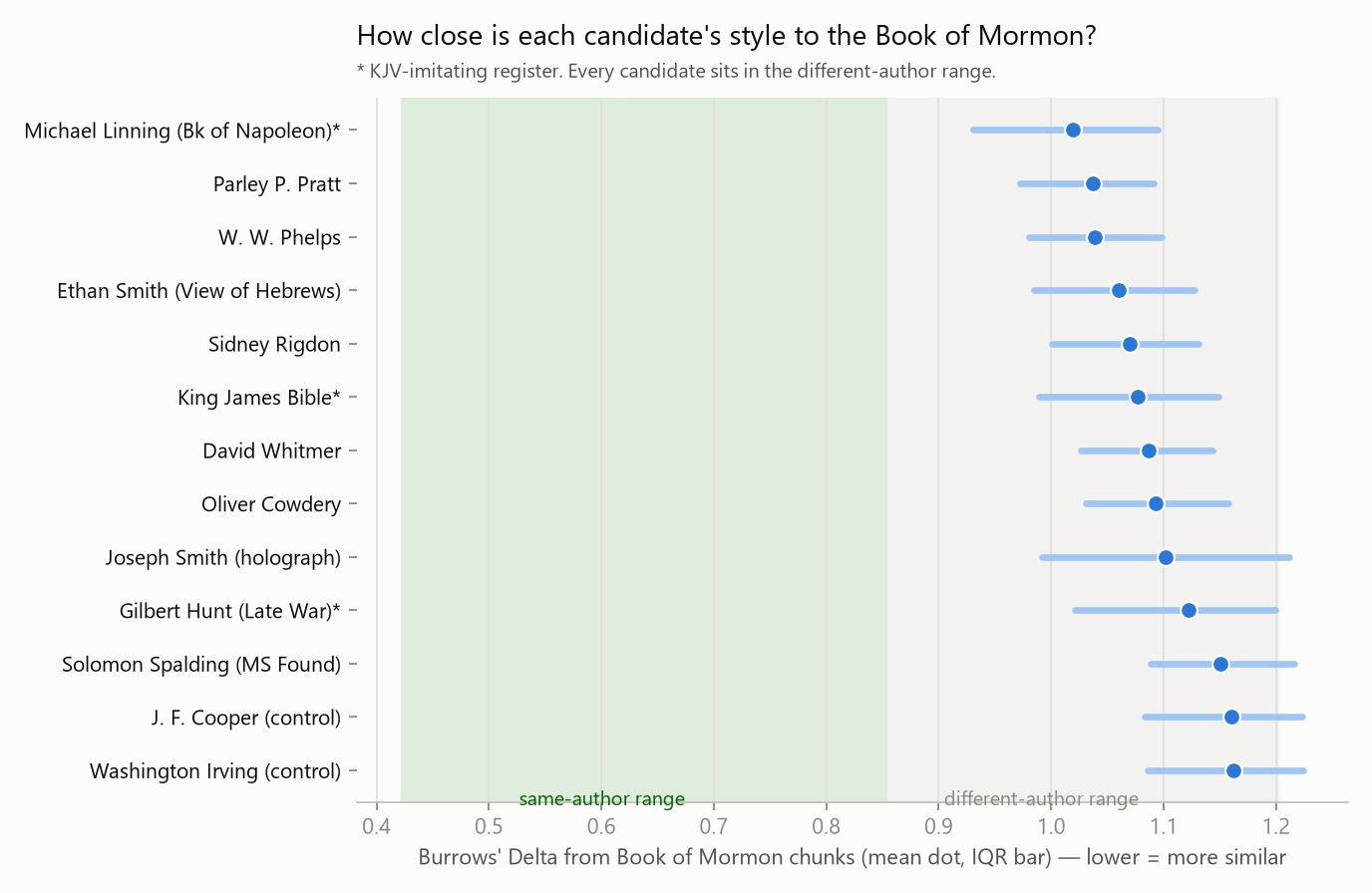
Figure 3. Candidate distances against calibrated same-author and different-author ranges. Every candidate lies in the different-author range. Spalding is among the farthest; the nearest is the register control.
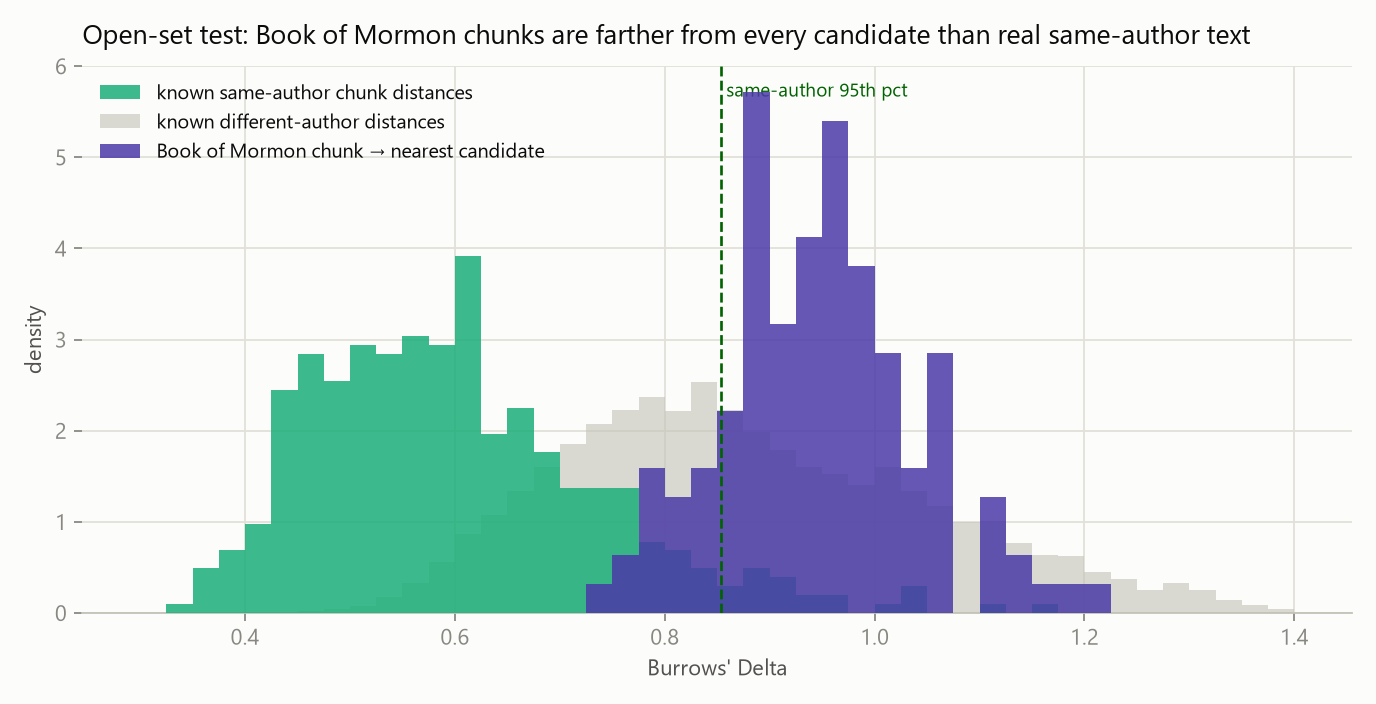
Figure 4. Open-set test. 82.9% of Book of Mormon chunks (86.2% under the no-archaic feature set) lie beyond the same-author 95th percentile from their nearest candidate; median nearest distance 0.951 vs. same-author mean 0.600.
Three features of Table 4 warrant emphasis. First, the closed-set “winner” is Linning — an author with no historical connection to the Book of Mormon, included precisely because his text shares its imitation-KJV register — followed by the KJV itself; closed-set votes here track register, not authorship. Second, Joseph Smith's 22 votes concentrate in the small-plates narrators (Jacob 4/6, Nephi 3/19 chunks), but even the closest narrator-candidate median (Jacob→Smith, Δ = 0.944) exceeds the same-author 95th percentile: no candidate attains same-author proximity for any narrator. Third, Spalding receives zero votes and near-maximal distances; Rigdon 6 votes and mid-table distances. The lesion test explains how a closed-set design can nonetheless produce confident attributions: with Cooper withheld, 62 of his 74 chunks (84%) are assigned to Irving; with Spalding withheld, his chunks scatter to Cooper and E. Smith. A forced-choice method always names someone.
4.4 The Book of Mormon's lexical profile
Table 5. Most over- and under-used marker words in the Book of Mormon relative to the candidate corpus space (mean z across chunks; rate per 1,000 words).
| Over-used | z | per 1k | Under-used | z | per 1k |
|---|---|---|---|---|---|
| came | +2.85 | 6.45 | a | −1.27 | 7.78 |
| should | +2.66 | 4.58 | on | −1.24 | 1.56 |
| that | +2.58 | 26.14 | in | −1.01 | 13.73 |
| they | +2.16 | 17.15 | as | −0.98 | 3.84 |
| unto | +2.11 | 13.82 | at | −0.95 | 1.47 |
| people | +2.05 | 6.67 | an | −0.92 | 1.37 |
| now | +1.84 | 4.81 | so | −0.90 | 1.36 |
| many | +1.65 | 2.91 | some | −0.86 | 0.30 |
| them | +1.56 | 10.01 | from | −0.78 | 3.60 |
| land | +1.44 | 4.83 | its | −0.77 | 0.14 |
The profile is a sustained oral-formulaic narrative pastiche: the “(and it) came (to pass)” formula, elevated subordination (that, should), archaic unto, thematic people/land, and depressed article and preposition rates. It is internally consistent across narrators and unlike every candidate's natural prose.
4.5 Robustness
Cosine Delta reproduces the pattern exactly (validation blocked κ = 0.89; narrators 0.25; null −0.16). Removing 27 archaic markers before feature selection leaves all conclusions unchanged (open-set exclusion rises to 86.2%). Results are stable across the w × m grid (Tables 2–3). Feature standardization on candidates only vs. the full corpus does not alter candidate ordering.
5Discussion
RQ1 is answered affirmatively: at 2,000-word chunks and 100 MFW the pipeline recovers known authorship across genres and registers, including between two independent KJV imitations, and degrades gracefully at small corpus sizes. The instrument is adequate to detect the effects claimed in the literature, were they present.
RQ2: the multiple-voices claim of the wordprint literature does not survive its controls. The naive design certifies known-fake narrators nearly as strongly as the real ones; under blocking, narrator discrimination falls to κ ≈ 0.2 — nominally significant by permutation (p = .035) but an order of magnitude below real-author separation, wholly unattributable for the smaller narrators (Jacob, Moroni, and all embedded orators at 0.00 recall), and confounded with genre and dictation order. Our result is consistent with Holmes (1992) and inconsistent with Larsen et al. (1980) and Hilton (1990), whose designs we show to be structurally capable of manufacturing their result.
RQ3: open-set attribution finds no candidate within same-author range of any part of the Book of Mormon, consistent with Schaalje et al. (2011). Our data are actively adverse to the Spalding–Rigdon hypothesis of Jockers et al. (2008): with the actual Spalding manuscript and a 74,000-word curated Rigdon corpus in the pool, Spalding is among the most distant candidates (zero closed-set votes) and Rigdon mid-table at best. The lesion experiment quantifies the mechanism by which closed-set NSC could nonetheless output confident Rigdon/Spalding attributions: absent the true author, 84% of a known author's text is confidently misassigned. The closed-set winner here — a register control with no historical connection — is a reductio of that design for this problem.
What stylometry cannot decide: whether Joseph Smith (or any candidate) could have produced the Book of Mormon's idiom when deliberately writing scripture-pastiche narrative. No candidate left such a text in his own hand; register and genre are known to shift function-word profiles within an author, and Smith's uncontested corpus is small (19,825 words) and generically remote (letters, memoir). The open-set result therefore excludes candidates' natural prose styles, not candidates. Symmetrically, nothing in these data supports multiple authorship: the text behaves as one sustained idiom.
6Limitations
Genre/register confound (both directions). Candidates are represented by letters, editorials, pamphlets and fiction, not scripture pastiche; the Book of Mormon's distance from all of them partly reflects register. This weakens candidate exclusion and equally weakens any claim that the text's distinctiveness implies ancient origin.
Transmission layers. The Book of Mormon was dictated, scribally recorded, and typeset; candidate texts passed through printers; four corpora are OCR. Function-word rates are comparatively robust, and the noisiest corpus (Spalding) still validates at 0.69, but noise inflates distances somewhat — it cannot, however, produce the systematic ordering observed (OCR noise does not explain why Spalding is maximally distant while OCR-derived Linning is minimally distant).
Edition effects. The analysed Book of Mormon is the current edition; Pratt follows an 1881 posthumous edition; Whitmer wrote in 1887, 57 years after the comparison period.
Segmentation granularity. Narrator and speaker maps are chapter-level; verse-level speaker attribution (as in Larsen et al.) could not be reproduced exactly. Both our schemes agree, and misassignment noise cannot explain zero recall for whole books (Jacob, Moroni).
Residual dependence. Even blocked chunks of one narrator share subject matter across books; this biases blocked results in favour of narrator discrimination, i.e., against our conclusion — the true authorial κ is if anything lower than 0.21.
Corpus asymmetries. Candidate corpora range from 19,825 to 148,434 words; validation cap-12 runs bound the small-sample penalty (κ ≈ 0.83), which does not close the gap to same-author range for any candidate.
Analytic scope. Function-word stylometry is one instrument. Syntactic, phraseological (n-gram), and intertextual methods (e.g., documented Late War / View of the Hebrews parallels) address different questions and are outside this study's claims.
7Conclusion
Under a pipeline validated on known authors of the same era and registers, the Book of Mormon shows (a) no reliably recoverable internal author structure once adjacency leakage is controlled — the wordprint studies' design certifies fake narrators as readily as real ones; and (b) no stylistic match to any tested 19th-century candidate under open-set assumptions — with Spalding and Rigdon, the classical secular candidates, among the worst matches, and closed-set designs shown to misattribute by construction. The text presents as a single sustained pseudo-biblical idiom. Function-word stylometry, honestly applied, supports neither the apologetic wordprint argument nor the Spalding–Rigdon attribution, and the debate over the book's origin must rest on other classes of evidence.
Data and code availability
The accompanying directory contains: prepare_bom.py (segmentation and exclusions), prepare_spalding_kjv.py, prepare_controls.py (cleaning), stylo.py (features, Delta, LOO-NN, κ), analysis_validation.py, analysis_internal.py, analysis_attribution.py, analysis_permutation.py, distinctive_words.py, plotting scripts, all cleaned corpora, per-document provenance manifests (corpus/raw/*/MANIFEST.md) recording title, date, source URL, scribal status, and authorship confidence for every document, and all numeric outputs (results/*.txt). Rerunning the scripts reproduces every number and figure in this manuscript.
References
Burrows, J. (2002). 'Delta': A measure of stylistic difference and a guide to likely authorship. Literary and Linguistic Computing, 17(3), 267–287.
Evert, S., Proisl, T., Jannidis, F., Reger, I., Pielström, S., Schöch, C., & Vitt, T. (2017). Understanding and explaining Delta measures for authorship attribution. Digital Scholarship in the Humanities, 32(suppl. 2), ii4–ii16.
Hilton, J. L. (1990). On verifying wordprint studies: Book of Mormon authorship. BYU Studies, 30(3), 89–108.
Holmes, D. I. (1992). A stylometric analysis of Mormon scripture and related texts. Journal of the Royal Statistical Society, Series A, 155(1), 91–120.
Jockers, M. L., Witten, D. M., & Criddle, C. S. (2008). Reassessing authorship of the Book of Mormon using delta and nearest shrunken centroid classification. Literary and Linguistic Computing, 23(4), 465–491.
Larsen, W. A., Rencher, A. C., & Layton, T. (1980). Who wrote the Book of Mormon? An analysis of wordprints. BYU Studies, 20(3), 225–251.
Mosteller, F., & Wallace, D. L. (1964). Inference and Disputed Authorship: The Federalist. Addison-Wesley.
Schaalje, G. B., Fields, P. J., Roper, M., & Snow, G. L. (2011). Extended nearest shrunken centroid classification: A new method for open-set authorship attribution of texts of varying sizes. Literary and Linguistic Computing, 26(1), 71–88.
Appendix A. Segmentation of the Book of Mormon
Table A1. Chapter-level narrator assignment (215 retained chapters, 252,099 words).
| Narrator | Chapters | Words |
|---|---|---|
| Nephi | 1 Nephi 1–19, 22; 2 Nephi 1–5, 11, 25–33 | 39,874 |
| Jacob | 2 Nephi 6, 9, 10; Jacob 1–7 | 13,376 |
| minor (excluded) | Enos; Jarom; Omni | 3,285 |
| Mormon | Words of Mormon; Mosiah; Alma; Helaman; 3 Nephi (retained); 4 Nephi; Mormon 1–7 | 169,564 |
| Moroni | Mormon 8–9; Ether; Moroni | 26,000 |
Table A2. Speaker-level additions (secondary scheme).
| Speaker | Chapters | Words |
|---|---|---|
| Benjamin | Mosiah 2–5 | 5,564 |
| Abinadi | Mosiah 12–17 (less 14) | 4,619 |
| Alma | Alma 5, 7, 36–42 | 11,978 |
| Amulek | Alma 34 | 1,574 |
| Samuel | Helaman 13–15 | 3,917 |
Table A3. Excluded KJV block quotations (24 chapters, 14,839 words).
| Book of Mormon chapters | KJV source |
|---|---|
| 1 Nephi 20–21 | Isaiah 48–49 |
| 2 Nephi 7–8 | Isaiah 50–51 |
| 2 Nephi 12–24 | Isaiah 2–14 |
| Mosiah 14 | Isaiah 53 |
| 3 Nephi 12–14 | Matthew 5–7 |
| 3 Nephi 22 | Isaiah 54 |
| 3 Nephi 24–25 | Malachi 3–4 |
2 Nephi 26–27 (dense Isaiah 29 paraphrase) and Mosiah 12 (partial Isaiah 52 / Exodus 20 quotation) were retained and flagged; excluding them as well does not change any reported result.
Appendix B. Candidate corpus curation summary
Full per-document detail (title, date, source URL, scribal status, authorship confidence, cleaning notes) is recorded in corpus/raw/<author>/MANIFEST.md. Curation highlights: Joseph Smith — only documents the Joseph Smith Papers identifies as holograph, or dictated with JS corrections (the two Liberty Jail epistles), were included; all scribe-kept journal entries were excluded using JSP handwriting markup. Rigdon — the archive.org OCR of the 1840 Appeal was rejected in favour of a human transcription after inspection found corrupted function words; embedded affidavits and the appendix were removed. Cowdery — the 1839 “Defence” was excluded as a probable 20th-century forgery; Warren A. Cowdery's editorials were specifically screened out. Phelps — unsigned editorials in issues he edited are attributed to him with confidence “medium”; unmarked embedded scripture was removed by an archaic-diction density filter with manual adjudication of borderline paragraphs. Pratt — Chapter VII (a two-column KJV contrast table) was removed entire. Whitmer — his own 1881 proclamation, reprinted in the 1887 pamphlet, was retained as his authorship.