July 2026 · Every number in this document comes from re-runnable analysis scripts; sources, code, and full data accompany the study files.
Why these studies, and how to read them
Arguments about the Book of Mormon's origin lean heavily on textual claims: that its internal authors have measurably distinct writing styles; that it shares over a hundred rare phrases with an 1816 book; that it reproduces — or deliberately corrects — the King James Bible's italicized words; that its pre-Christian prophets speak in New Testament language. These claims are checkable. The four studies summarized here check them, applying one standard throughout: no number counts as evidence until a control shows what an unrelated text scores on the same test.
That standard cuts in both directions, and the results below do too: two celebrated arguments used against the Book of Mormon fail their controls, and two arguments used in its defense fail theirs. The studies were run with the explicit goal of finding out what is true, not of helping either side.
TERMS USED THROUGHOUT
Phrase / n-gram: an exact sequence of n consecutive words (“and it came to pass that” is a 5-gram). Register: a manner of writing — here, the imitation-King-James style (“pseudo-biblical”) that was a recognizable genre in the early 1800s. Burrows' Delta (Δ): the standard forensic measure of how differently two texts use the most common words (the, of, unto, that…), which authors use unconsciously. Calibrated on known authors of the same era: text by the same author typically scores Δ ≈ 0.6, and 95% of same-author text scores below 0.85; different authors typically score Δ ≈ 0.9 and above. Control text: a text chosen because it shares the incidental features of the comparison (era, genre, register) but cannot share the claimed cause (influence, common authorship). Whatever the control scores is the baseline any real evidence must beat.
Study 1 — Does the Book of Mormon borrow from The Late War?
Background
The Late War Between the United States and Great Britain (Gilbert Hunt, 1816) is a history of the War of 1812 written, as a stylistic exercise, in the language of the King James Bible — chapters, verses, and “it came to pass.” It was used as a school text in New York while Joseph Smith was growing up there. In 2013 a computational study (the WordTree Foundation) reported that the Book of Mormon shares more than 100 rare phrases with it, and the finding spread widely as evidence of borrowing. Defenders of the Book of Mormon called the phrase list cherry-picked. Neither side ran the obvious control.
What the study did
We counted every distinct 4-, 5-, and 6-word phrase shared between the Book of Mormon and each comparison text, after first discarding every phrase that appears anywhere in the King James Bible (both texts imitate it, so KJV phrasing proves nothing), and normalizing for text length. The comparison set included the claimed sources (The Late War, View of the Hebrews, Spalding's manuscript), two ordinary prose controls (Irving, Cooper) — and the register control: The First Book of Napoleon (1809), a King-James-style war chronicle published in Edinburgh by a Scottish lawyer, with no American edition and no conceivable connection to Joseph Smith.
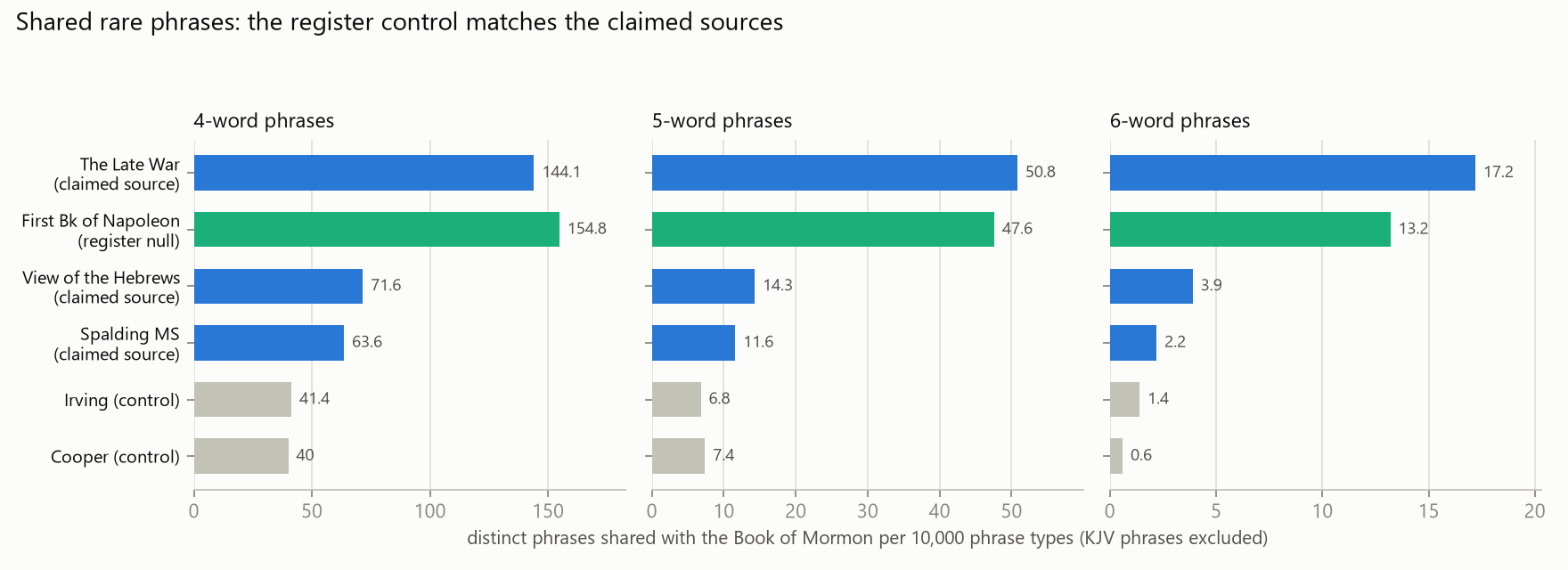
Shared-phrase rates, all comparison texts. Blue: texts claimed as Book of Mormon sources. Green: the register control, which no one claims Joseph Smith ever saw. Grey: ordinary prose of the same era.
What it found
The raw claim replicates — and then dissolves. The Book of Mormon does share 235 exclusive 5-word phrases with The Late War, comfortably over the famous “100+.” But the unconnected Scottish control performs the same: 47.6 shared 5-grams per 10,000 versus The Late War's 50.8, and more at 4 words. Three further checks sealed the interpretation:
The pseudo-biblical texts share with each other. The Late War and the Book of Napoleon share 17.5 phrases per 10k with no Book of Mormon involved — the highest rate of any pair not involving the Book of Mormon. Irving and Spalding — two texts nobody has ever connected — share 14.2.
Size-matched, the special affinity vanishes entirely. The Book of Mormon is much longer than the other texts, which inflates its raw counts. Cut into Late-War-sized slices, the rates are: Book of Mormon ↔ Late War 15.3, Book of Mormon ↔ Napoleon 13.2 — both BELOW Late War ↔ Napoleon at 17.5. On equal footing the Book of Mormon is no closer to The Late War than two independent King-James imitations are to each other.
Real borrowing looks nothing like this. Where the Book of Mormon actually uses a source — its quoted King James chapters — it runs 93% verbatim for chapters at a stretch (Study 2). Fifteen shared phrases per ten thousand is what genre-mates score; ninety-three percent verbatim is what copying looks like.
WHAT THIS DOES AND DOES NOT SHOW
The phrase-count argument for Late War borrowing should be retired — by everyone. But the finding strengthens a more fundamental point: pseudo-biblical narrative was a living genre in Joseph Smith's world, and membership in that genre automatically produces the features — “and it came to pass,” Hebraism-like constructions, biblical cadence — that defenders cite as marks of ancient origin. The Book of Mormon's language is at home in the 1810s. Separately, the specific content parallels with The Late War (two thousand “stripling” soldiers, a “title of liberty,” a river battle red with blood) are untouched by this analysis and stand or fall as ordinary qualitative evidence. (See The Book of Mormon and The Late War Companion Document)
“Couldn't Joseph have read the Book of Napoleon too?” Historically unlikely (Edinburgh imprint, no American edition) — but the deeper answer is that the question concedes the point. Once phrase-sharing at this rate requires us to suppose Joseph read every elevated text — and that Hunt read Linning, and Irving read Spalding — the statistic has stopped identifying sources and started identifying a genre. A measurement that fires for unrelated texts cannot certify a related one.
Study 2 — The King James italics
Background
The King James translators worked word-by-word from Hebrew and Greek, and where English grammar forced them to supply a word with no counterpart in the original, they printed it in italics — a typographic confession, visible on every page of a printed KJV. Example: at Isaiah 51:15 the King James reads “I am the Lord thy God,” where the italicized am was supplied by the translators — it has no counterpart in the Hebrew. This creates a clean test. Critics have long pointed out that the Book of Mormon's quoted Bible chapters reproduce these italicized words — English editorial insertions inside a record claimed to predate English. Defenders, following Royal Skousen's textual work, counter that the Book of Mormon's changes to the King James text cluster at the italicized words, which they read as inspired correction of the translators' guesses. Both sides cite examples; neither side's full count was public.
What the study did
Using a digital King James text that preserves the italics markup, we aligned all 24 chapters the Book of Mormon quotes wholesale (Isaiah, Matthew 5–7, Malachi 3–4) word by word — 14,236 King James words, 473 of them italicized — and recorded, for every word, whether the Book of Mormon keeps or changes it.
| MEASURE | RESULT |
|---|---|
| KJV wording retained verbatim overall | 93.4% of 14,236 words |
| Italicized (translator-invented) words retained | 293 of 473 (62%) |
| Rate of change at italicized words | 38.1% |
| Rate of change at ordinary words | 5.6% |
| Concentration of changes at the italics | 6.9× the background rate |
What it found — both sides are right, and it settles the question
The critics' count stands: 62% of the English words the 1611 editors invented sit verbatim in text presented as an ancient record, inside chapters that track one specific English edition at 93% fidelity. The defenders' pattern also stands: changes really do cluster at the italics, at 6.9 times the background rate. But follow that second fact to its conclusion. Italics are not a property of the words; they are a property of the printed page. They cannot be heard in dictation, seen in a vision, or carried by any ancient source — the only way to edit preferentially at the italicized words is to be looking at a printed King James Bible while producing the text. The pattern defenders cite as evidence of inspiration is, examined closely, physical evidence of the 1769 KJV open on the table — with most of its editorial guesswork (the 62%) transcribed unchanged into the “ancient” record.
“Couldn't God have used the familiar King James wording for the reader's benefit?” That defense covers the 93% retention. It does not explain why the divine translation's departures from the King James text track the typography of one printed edition — italics the ancient plates could not contain and a non-reading translation could not see.
Study 3 — New Testament language in pre-Christian mouths
Background
The Book of Mormon presents its early narrators — Nephi, Jacob, and their successors — as Israelites writing between roughly 600 and 130 BCE, centuries before Christianity. The standard critical observation is that these authors preach fully developed Christian doctrine. The standard defense is that they had prophetic foreknowledge of Christ. That dispute is theological — but underneath it sits a checkable textual question: how much distinctively New Testament LANGUAGE (in its King James form) do these pre-Christian authors use? Wording that first appears in Greek texts of the first century CE, in the English of 1611, has no route into a Hebrew record of 600 BCE — foreknowledge of events does not deliver the phrasing of documents not yet written.
What the study did
We extracted every 4-, 5-, and 6-word phrase that occurs in the King James New Testament but nowhere in the entire Old Testament, then counted how many appear in the Book of Mormon's pre-Christian text (with all directly quoted Bible chapters removed first). The cleanest tier is the small plates (1 Nephi through Omni) — 56,607 words presented as written personally by authors living 600–130 BCE.
| PHRASE LENGTH | DISTINCT NT-ONLY PHRASES IN THE SMALL PLATES | TOTAL OCCURRENCES |
|---|---|---|
| 4 words | 1,367 | 2,344 |
| 5 words | 567 | 960 |
| 6 words | 240 | 362 |
That is roughly one New-Testament-exclusive phrasing per hundred words. And they are not incidental wording — the most frequent include “the power of the Holy Ghost,” “the twelve apostles of the Lamb,” “the kingdom of God,” “lake of fire and brimstone,” “the Lamb of God,” and, in the wider pre-Christian narrative, “the resurrection of the dead,” “the foundation of the world,” and “the church of God.” The full ranked lists accompany the study files.
“A translator would naturally render ancient ideas in the Bible English he knew.” This is the strongest defense, and it deserves a precise answer: it explains idiom, not content. If the underlying ancient text contained the concepts, a King-James-style translation of them would sound like this. But that requires the concepts — apostles numbered twelve, an organized church of God, the Holy Ghost's power, New Testament eschatology — to exist in pre-exilic Israelite religion, which is precisely what the historical record denies. The census does not refute the translator defense so much as price it: to accept it, one must hold that sixth-century BCE Israel possessed first-century CE Christianity wholesale — which is the anachronism claim, now with a number attached.
Study 4 — The Book of Mormon beside Joseph Smith's other scripture
Background
A full stylometric study (the companion analysis to this document) tested the two famous authorship claims. The method was first validated: it identifies known authors of the same era from 2,000-word samples with ~90% accuracy, even distinguishing two different King-James imitators from each other. Against that working instrument, both celebrated claims failed. The LDS “wordprint” studies' finding of distinct internal authors evaporates under proper controls (the same test design certifies fake narrators carved from a single narrator's text, and the real narrators score barely above chance once that flaw is fixed). And the 2008 Spalding–Rigdon attribution proves to be an artifact of forcing every chapter to pick someone from a fixed list — by direct measurement, Spalding is among the farthest candidates from the Book of Mormon tested. But that study left one gap, which its own authors flagged: every candidate was represented by ordinary prose (letters, editorials, fiction), while the Book of Mormon is scripture-pastiche narrative — a different genre, which shifts style measurements by itself. One man left corpora in BOTH genres: Joseph Smith.
What the study did
We added Joseph Smith's other dictated scripture to the comparison: the Doctrine & Covenants revelations (100,926 words, excluding sections authored by others and extracts of letters already counted), the Book of Moses, and the Book of Abraham. First, a calibration: Joseph's personal letters measure Δ = 0.88–0.91 from his own revelations — one man's two genres register as “different authors.” That yardstick governs everything: at these distances, the method cannot tell a different author from the same author writing in a different genre.
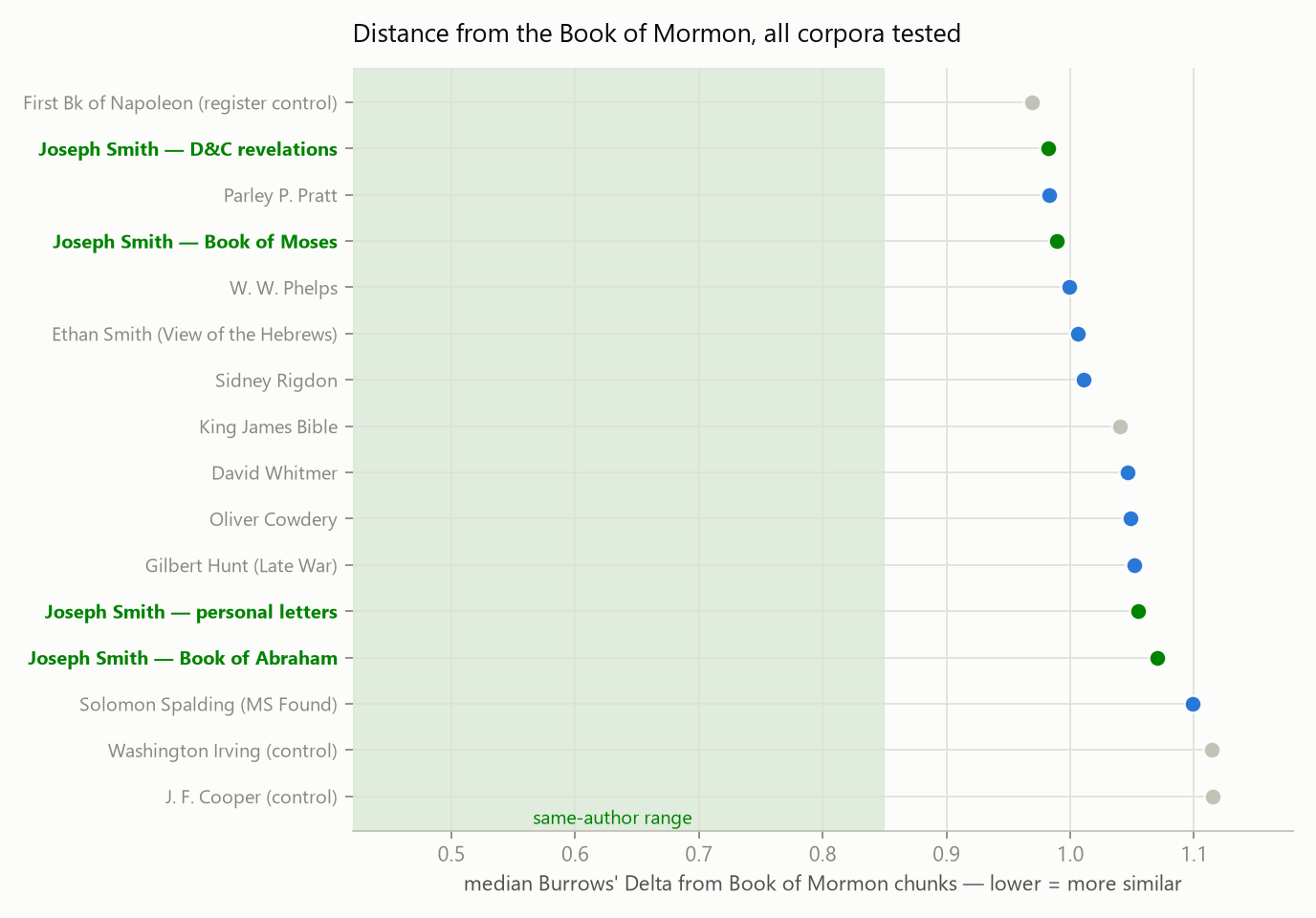
Median stylistic distance from the Book of Mormon to every corpus tested. Green: Joseph Smith's corpora. Note his dictated scripture (D&C, Moses) near the top and his personal letters far down the list — the gap between them is the genre effect. Grey band: the range within which known same-author text falls.
What it found
Genre, not person, explained Joseph Smith's earlier low rank. Once his scripture-voice corpora enter the comparison, they become the nearest real candidates (D&C at Δ = 0.982, Book of Moses 0.989) and receive 55% of all forced-choice votes — while his letters stay far down the list.
But the Book of Mormon is not simply the D&C. The two remain reliably distinguishable (a classifier separates them with 98% accuracy on D&C samples), and only a fifth of Book of Mormon chunks fall within known same-author range of the D&C. Near neighbours; not one voice.
No other person's writing comes close. Spalding and Rigdon — the perennial alternative authors — sit far below every Joseph Smith scripture corpus, below even his letters in Spalding's case.
READ IT BOTH WAYS — THIS IS THE HONEST LIMIT
A skeptic reads this as consistency: the Book of Mormon's nearest stylistic relatives are the pseudo-biblical genre of Joseph Smith's day and Joseph Smith's own dictated output — exactly what single modern production predicts. A believer can reply that God's word through one man should sound consistent across the Book of Mormon and the D&C, so the proximity confirms nothing sinister. Both readings survive this data; the register yardstick (one man's genres = “different authors”) means stylometry cannot break the tie. What does NOT survive is any stylometric argument FOR the book: the internal-voices wordprint claim fails its controls, the ancient-authors hypothesis gains nothing from a text whose closest measured relatives are all products of the 1810s–1840s, and the Spalding–Rigdon theory is actively disfavored. After four studies, stylometric and phrase evidence neither convicts Joseph Smith of authorship nor supplies a single datum in favor of antiquity.
What the four studies add up to
Taken together: the Book of Mormon's language is native to a popular genre of Joseph Smith's own era (Study 1); its quoted scripture carries the fingerprints of a specific printed 1769 English Bible, down to edits that track its typography (Study 2); its pre-Christian authors speak in measurably New Testament phrasing at a rate of one exclusive phrase per hundred words (Study 3); and its closest stylistic relatives in a sixteen-corpus comparison are the genre itself and Joseph Smith's other dictated scripture — with the classical alternative authors, Spalding and Rigdon, effectively excluded (Study 4). None of this is a laboratory proof of authorship; all of it is systematically easier to explain if the Book of Mormon is a work of the nineteenth century than if it is a translation of an ancient record. Equally important is what these studies retire: the “100+ rare phrases” statistic, the naive wordprint argument, and the Spalding–Rigdon attribution do not survive their controls, and honest cases — on either side — should stop using them.
Sources and reproducibility
Full methods, corpus provenance (per-document manifests with source URLs and authorship-confidence ratings), sensitivity analyses, and limitations are documented in the companion manuscript “Stylometric Analysis of the Book of Mormon” and the study scripts (stylometry/ directory: scripts study1–study4, results/, corpus/). Texts: Book of Mormon, D&C, and Pearl of Great Price from bcbooks/scriptures-json; KJV with italics markup from eBible.org; The Late War, The First Book of Napoleon, View of the Hebrews, and the Spalding manuscript from archive.org; Joseph Smith documents from Joseph Smith Papers verbatim transcripts (holograph/dictated only); candidate corpora as documented in the manifests. Every figure and number regenerates from the scripts.